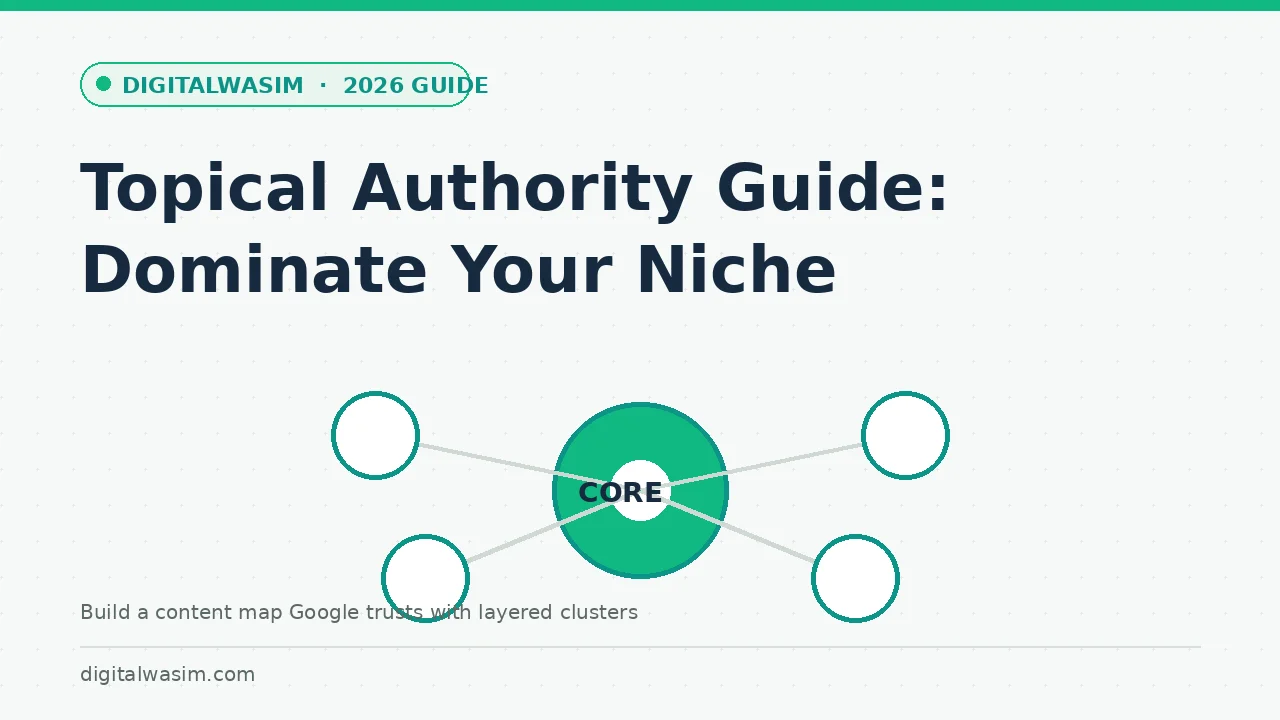
Two blogs can publish the same number of articles, target similar keywords, and get completely different results. One site sees every new post rank within weeks; the other waits months for impressions that never come. The difference is rarely luck or budget. It is topical authority: the degree to which search engines believe your site genuinely owns the subject you write about, based on the depth, structure, and consistency of everything you have published.
This topical authority guide turns that fuzzy idea into a working system. You will learn how to choose a topic core you can actually dominate, map it into pillars and clusters, connect everything with internal links that make sense to readers, and measure whether Google is starting to treat you as the go-to source. Every tactic here is white hat, applies to a brand-new blog or an established one, and gets easier the moment you stop chasing random keywords and start building coherent coverage.
Quick answer:What Is Topical Authority, Exactly?
Topical authority is the search engine's answer to a hard question: out of thousands of pages about this subject, whose should we trust? Instead of judging every page in isolation, Google looks at the site around the page. Does the site cover this topic broadly? Do its articles reference each other? Has it published on adjacent subtopics that real experts would recognize? A site that answers yes to those questions gets a ranking lift that no single article can earn alone.
SEO starter guide helpful content documentationThere is also a user-behavior logic underneath it. Readers who find one complete answer on your site click to a second article, subscribe, and search your brand name later. Those engagement patterns reinforce the authority signal. Topical authority compounds because it is good for readers first and algorithms second.
Why Topical Authority Matters More in 2026
In 2026, topical authority matters more than at any point in blogging history, for three concrete reasons. First, search results are no longer a simple list of blue links. AI overviews, featured snippets, and community results all pull from sources the systems consider authoritative on the topic, and comprehensiveness is how that judgment gets made. Second, AI content generation made generic articles worthless; millions of posts now say nothing new. Depth and first-hand experience are the remaining differentiators.
Third, link building alone no longer compensates for thin coverage. Plenty of sites with strong backlink profiles rank poorly because their content has no coherent theme, while focused small sites outrank them with a fraction of the links. That inversion was rare five years ago and is now common in most niches. The practical takeaway: if your publishing plan is a random keyword list, you are competing with a handicap, because you are telling Google nothing about what your site is for.
guest postingChoosing a Topic Core You Can Actually Dominate
Topical authority starts with a topic core: the subject you want to be known for, phrased narrowly enough that dominating it is realistic. Help bloggers grow is not a topic core; it is an industry. Email marketing for course creators is closer. The narrower core feels limiting, but it is the entire trick: within a small pond, comprehensive coverage is achievable, and comprehensiveness is what the ranking systems reward.
Test your candidate core with three questions. Can you list at least thirty real questions people ask about it? Do you have experience or access that makes your answers better than the average search result? Are the current top-ranking sites beatable on depth rather than just brand? If any answer is no, narrow the core further. A smaller core with full coverage beats a bigger core with holes, and you can always expand outward once one area is won.
low-competition keyword methodThe Three-Layer Topical Map: Pillar, Clusters, Supporting
With a validated core, structure your coverage in three layers. The table below shows the role each layer plays and how they connect, using a budget travel blog as a concrete example.
| Layer | Job | Example | Link Role |
|---|---|---|---|
| Pillar page | Own the head term, overview the whole subject | Complete guide to budget travel in Asia | Links out to every cluster post |
| Cluster posts | Answer one specific question thoroughly | Best travel insurance for backpackers | Links up to pillar, sideways to siblings |
| Supporting assets | Tools, templates, case studies, data posts | Three-month Southeast Asia budget spreadsheet | Earns links, feeds traffic to both layers |
The proportions matter more than the labels. One strong pillar per topic core, six to ten cluster posts around it, and a supporting asset or two that gives the topic something linkable. A site with five pillars and zero clusters has five declarations of intent; a site with one pillar and ten clusters has an actual resource.
Connecting the Map: Internal Links That Build Structure
Internal linking is the nervous system of topical authority. Search engines discover how your topic fits together largely by following your links, so a cluster that is published but not connected is invisible as a structure. Every cluster post needs a link up to the pillar in its first few paragraphs, two or three links sideways to sibling posts where a reader would naturally want more depth, and the pillar needs a section linking down to every cluster post.
A full internal linking strategy Google's guidance on crawlable links proper Google Search Console setupPublishing Cadence and Depth That Compounds
Consistency is the part of topical authority nobody can shortcut. Publishing two focused cluster posts per week for three months builds a coverage map that algorithms and readers both recognize; publishing twelve posts in one burst and then going silent does not. A regular cadence also gives each post time to earn impressions, so you can learn which angles resonate before writing the next batch.
structured writing process content refresh routineMeasuring Topical Authority in Search Console
You do not need a third-party authority score to know whether this is working, because Google Search Console tells you directly. In the Performance report, watch for three patterns appearing together: new posts gaining impressions within a week of publishing, several of your URLs ranking for the same query cluster, and long-tail queries surfacing that you never explicitly targeted. That third pattern is the clearest signal that Google has connected your topic map and is testing your site across the whole subject.
Give each pattern a monthly check so you can react while the trend is fresh. If impressions plateau across the cluster, the fix is usually more depth: add the missing subtopics, strengthen the pillar, or publish the supporting asset the topic lacks. If clicks lag behind impressions, your titles and meta descriptions need work, because authority earns visibility while copy earns the click.
Set a realistic review horizon too. Topical authority compounds over quarters, not days, so judge your topic map every ninety days rather than every week. Sites that survive the slow first quarter almost always see the second quarter accelerate, because each new cluster post lifts everything published before it.
Six Mistakes That Reset Your Progress
Before wrapping up, here are the failure patterns that keep blogs from ever gaining topical traction. Each one is common, and each one is fixable today:
- Chasing high-volume keywords outside your core because a tool flagged them as easy, which scatters your coverage.
- Publishing a pillar page before any cluster exists, leaving an overview with nothing beneath it.
- Interlinking only through navigation menus instead of contextual links inside the content.
- Copying competitor outlines instead of adding the experience, data, or opinion that makes coverage unique.
- Abandoning the topic after one month and starting a new one, resetting progress to zero.
- Ignoring old cluster posts until they rank, then wondering why freshness-driven competitors pass them.
Notice that none of these failures are about talent. They are strategy errors, which means a focused blogger with average writing skills can outperform a talented one who refuses to pick a lane.
Topical authority is the closest thing blogging has to a compounding investment. Pick a core you can own, map it into a pillar and clusters, link them like you are building a reference book, publish on a cadence you can sustain, and refresh what ages. Do that for two quarters and the next article you publish starts with an advantage no scattered keyword strategy will ever match.